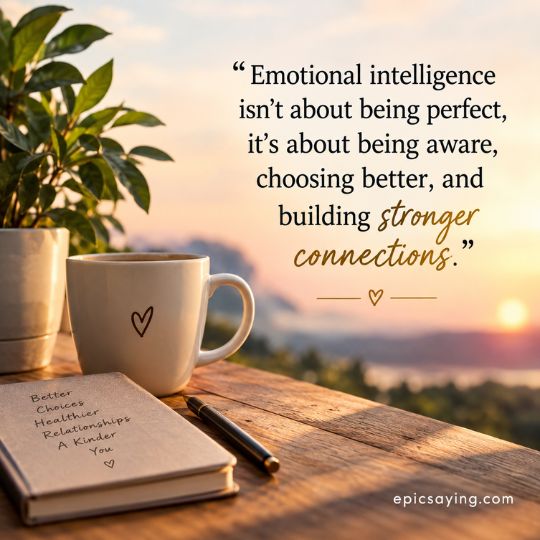
What Is Emotional Intelligence?
Emotional intelligence is the ability to recognize your own emotions, understand other people’s, and use that understanding to guide your behavior. Psychologists and writers such as Daniel Goleman have popularized models that usually include self-awareness, self-regulation, motivation, empathy, and social skills.
Why It Matters for Relationships
People who can name their feelings, listen well, and stay steady during conflict tend to build trust more easily. Emotional intelligence will not remove disagreement, but it can change how you handle it.
Why Use Quotes to Practice It
A short line is easy to remember in the middle of a tense moment. Pick one quote a week, repeat it often, and let it remind you to pause, listen, or breathe.
01 / 10
Emotional Intelligence Quotes About Self-Awareness
Self-awareness is where emotional intelligence begins. These quotes are about noticing your feelings, your patterns, and your triggers before they steer the conversation.
- Knowing what you feel is the first draft of knowing what you need.
- You can’t manage a mood you haven’t noticed.
- Self-awareness is a flashlight you point inward, not a spotlight you aim at yourself.
- Notice the reaction, then ask what it’s protecting.
- The pause before you speak is where self-awareness lives.
- Ask “why did that bother me?” and let the answer surprise you.
- Your habits are a mirror; look into it honestly.
- Some of what irritates you in others is a quiet message about you.
- A clear view of your strengths and your blind spots is the best map you can own.
- Awareness doesn’t judge; it simply sees.
- You learn more from watching your reactions than from defending them.
- Check in with your body; it often knows before your mind does.
- Self-knowledge is a skill built through small, honest check-ins.
- Being honest with yourself is the hardest and most useful conversation.
- Your triggers are teachers if you’re willing to listen.
- The more you know your values, the less you need anyone’s approval.
- Observe your thoughts like a curious scientist, not a harsh critic.
- You can’t change a pattern you refuse to name.
- Self-awareness turns “I always do this” into “I can do this differently.”
- Your mood is information, not a verdict.
- Admitting what you don’t know is a sign of growing wisdom.
- Before you blame the room, check the weather inside.
- Your energy tells the truth about your commitments.
- Awareness is noticing the story your mind is telling, and questioning the ending.
- The honest answer is usually quieter than the loud one.
- Know what drains you and what refills you, then plan your day around it.
- A journal page can be a mirror that doesn’t interrupt.
- Understanding how you come across starts with understanding how you feel.
- Growth begins on the day you stop explaining your habits and start examining them.
- The more clearly you see yourself, the more gently you can treat others.
02 / 10
Emotional Intelligence Quotes About Empathy
Empathy is the ability to understand what another person feels and to let them know they are not alone. These quotes celebrate curiosity, compassion, and presence.
- Empathy is the courage to feel with someone without trying to fix them.
- Everyone you meet is carrying a story you haven’t read.
- Listen with your whole face, not just your ears.
- Understanding someone doesn’t require agreeing with them.
- Empathy starts when curiosity replaces judgment.
- Imagine the day they had before you judge the way they spoke.
- A kind question can open a door that advice would close.
- To be seen is one of the deepest human needs, and empathy is how you give it.
- Put down your defense and pick up their perspective.
- Compassion is empathy that decides to act.
- You can be strong and soft at the same time.
- Sitting beside someone’s pain is a gift that needs no words.
- Behind most hard behavior is a tender need.
- Empathy is not agreeing; it’s acknowledging.
- When you hear “I’m fine,” listen for what’s underneath.
- Ask “what’s that been like for you?” and mean it.
- Treat people as the whole person, not their worst moment.
- Empathy makes the world smaller and kinder.
- Take a breath before you respond to someone’s hurt.
- Another person’s feelings are real even if they don’t make sense to you.
- To walk beside someone, you first have to stop walking ahead of them.
- Empathy is a muscle, and every honest conversation trains it.
- Don’t rush to comfort; first make room to listen.
- Say “that sounds hard” more often than “you should.”
- A moment of understanding can end a week of tension.
- Care about how your words land, not only how they sound.
- Seeing the person behind the problem changes the problem.
- Kindness costs little and tells people they matter.
- Being understood is a quiet kind of healing.
- Empathy begins at the edge of your own comfort.
03 / 10
Emotional Intelligence Quotes About Understanding Feelings
Emotions carry information. These quotes help you name what you feel, read the message underneath, and stop being surprised by your own reactions.
- Feelings are signals, not orders.
- Name it to tame it.
- Every emotion carries a message; your job is to translate it.
- Anger is often sadness wearing armor.
- You can feel two things at once, and both can be true.
- Don’t judge a feeling; get curious about it.
- Emotions are weather; your awareness is the window.
- What you push down tends to pop up somewhere louder.
- The more words you have for feelings, the less power confusion has.
- Fear is sometimes just care in disguise.
- A feeling felt fully usually passes faster than one avoided.
- Ask yourself, “What is this emotion trying to protect?”
- Sadness is love with nowhere to go.
- Frustration shows you what you care about.
- Emotions don’t need to be fixed; they need to be heard.
- Learning to read your feelings is like learning a second language.
- There are no bad emotions, only unhelpful reactions.
- Notice where the feeling lives in your body.
- Feeling overwhelmed often means feeling several things at once and naming none.
- Jealousy points to something you want.
- Make friends with your emotional weather.
- Sometimes “I’m tired” really means “I’m hurt.”
- A calm mind is not an empty one; it’s an understood one.
- Understanding your feelings is the first step to choosing your response.
- You’re allowed to feel before you know why.
- Joy deserves your attention as much as pain does.
- Emotions are honest even when they’re inconvenient.
- Your feelings aren’t too much; they’re information.
- The depth you feel is a sign of how much you can love.
- When you understand an emotion, it stops running the show.
04 / 10
Emotional Intelligence Quotes About Emotional Maturity
Emotional maturity shows up in how you handle disagreement, disappointment, and your own mistakes. These quotes are about growing up on the inside.
- Maturity is responding instead of reacting.
- A mature person can be wrong without falling apart.
- Growing up emotionally means owning your part without owning everyone else’s.
- You can disagree and still be kind.
- Maturity is saying “I need space” instead of slamming a door.
- Emotional maturity is staying open when it would be easier to shut down.
- Real strength admits when it needs help.
- You don’t have to win every argument to keep your peace.
- Apologize without adding a “but.”
- Let people be who they are and decide what that means for you.
- Maturity is learning that not every feeling needs an audience.
- You can love someone and still say no.
- Emotional growth shows up when you can hold discomfort without blaming.
- Choose the long-term relationship over the short-term point.
- Being mature means asking questions before drawing conclusions.
- A grown heart can hold both disappointment and gratitude.
- You stop needing drama when you start valuing peace.
- Maturity means expecting less from perfection and more from honesty.
- Take responsibility, then take the lesson.
- You can be hurt without being cruel.
- Don’t confuse silence with strength or noise with honesty.
- A mature mind knows that feelings are valid and behavior is chosen.
- Forgive yourself as quickly as you forgive your friends.
- Emotional maturity is not about never feeling anger but knowing what to do with it.
- Let go of the need to be understood by everyone.
- It takes maturity to celebrate someone else’s success.
- Don’t take everything personally; most things are about the other person’s day.
- Becoming mature means making peace with imperfect people, including yourself.
- Patience is maturity wearing comfortable shoes.
- Growth is learning to be as honest as you are gentle.
05 / 10
Emotional Intelligence Quotes About Self-Control
Self-control is the space between a feeling and a reaction. These quotes honor the pause, the deep breath, and the choice to respond well.
- Self-control is the space between impulse and action, widened.
- The pause is a superpower.
- You don’t have to say everything you feel the moment you feel it.
- Choose the response you’ll be proud of tomorrow.
- Self-control isn’t about suppression; it’s about direction.
- Count to ten, then choose.
- Strong people know when to stay quiet.
- Your future self is relying on your present restraint.
- Discipline is a gift to the person you’re becoming.
- Say less, mean more.
- Control your reaction, and the situation loses half its power.
- Take a walk before you send the message.
- Self-control grows from small wins, like putting the phone down.
- You can feel anger and still choose gentleness.
- The easy reply and the right reply are rarely the same.
- Willpower is easier when you design your day to support it.
- A calm answer is stronger than a clever comeback.
- Real freedom is not being ruled by every impulse.
- Sleep on it; most emotional emails look different in the morning.
- You are allowed to walk away from an argument.
- Restraint is not weakness; it’s strategy.
- Make a plan for your hardest moments before they arrive.
- Choose the long game over the quick reaction.
- Self-mastery is built one small refusal at a time.
- The word you don’t say can be the kindest thing you do.
- Notice the urge, name it, and let it pass.
- Self-control is simply being on your own side over time.
- Delay is the friend of good decisions.
- Don’t let a five-second feeling write a five-year story.
- You don’t have to act on every thought you have.
06 / 10
Emotional Intelligence Quotes About Managing Emotions
Managing emotions means steering them, not erasing them. These quotes offer simple reminders for settling strong feelings in a healthy way.
- Managing emotions is steering, not stopping.
- You can’t control the wave, but you can learn to surf.
- Breathe in for four, out for six, and watch the storm soften.
- Give your feelings room, not the steering wheel.
- A walk, a glass of water, and a deep breath can change a hard hour.
- Process first, respond later.
- You can hold a big feeling without letting it hold you.
- Take care of your body, and your emotions become easier to carry.
- Write it out before you speak it out.
- Move your body when your mind feels stuck.
- Emotions last longer when you fight them.
- Self-soothing is a skill worth practicing daily.
- Let yourself feel it, then let yourself release it.
- Talking to someone you trust can lighten what’s heavy.
- Rest is emotional first aid.
- Notice the first sign of stress, and act before it grows.
- You can honor a feeling without obeying it.
- Regulate first, then communicate.
- Calm is a habit you can build.
- It’s okay to step away until you can return with clarity.
- Clear boundaries make emotions easier to manage.
- Little rituals ground big feelings.
- Don’t make permanent decisions in temporary storms.
- Self-compassion is the fastest way back to balance.
- Release tension from your shoulders, jaw, and hands.
- Give yourself the care you’d give a friend in your position.
- Emotional balance is built in ordinary moments, not just in crises.
- What you do with a feeling matters more than the feeling itself.
- Healthy emotional habits are the quiet backbone of a good life.
- Come back to your breath, and you come back to yourself.
07 / 10
Emotional Intelligence Quotes About Relationships
Relationships rise or fall on how people handle feelings together. These quotes are about honesty, repair, trust, and showing up for the people who matter.
- Strong relationships are built on small moments of attention.
- Say what you mean, kindly.
- Listening is the love language of every healthy relationship.
- A good relationship is two people choosing understanding over winning.
- Repair matters more than never having conflict.
- Don’t expect people to read your mind; speak your needs.
- Trust is built in tiny, repeated acts of reliability.
- Ask “how are you, really?” and wait for the real answer.
- In every disagreement, remember you’re on the same team.
- Thank people out loud.
- Respect is the foundation that love is built on.
- Presence is the best gift you can give.
- Don’t bring yesterday’s argument into today’s conversation.
- A sincere apology can mend more than a thousand explanations.
- The way you handle tension says a lot about how you value the bond.
- Be honest about your feelings before they turn into distance.
- Healthy love leaves room for two whole people.
- Notice the effort, not just the outcome.
- Check your tone; it carries as much as your words.
- Good relationships feel safe enough for honest feelings.
- Say “I feel” before “you always.”
- Give people the benefit of the doubt before the benefit of your opinion.
- Connection grows when you’re curious about each other’s inner world.
- Healthy boundaries make closeness possible.
- Love is a verb you practice in ordinary moments.
- Let your partner, friend, or family member finish their sentence.
- Showing up consistently beats showing off occasionally.
- Share the good news as eagerly as you share the problems.
- Forgiveness is a gift you give both ways.
- The strongest bonds are forged by honesty offered with care.
08 / 10
Emotional Intelligence Quotes About Staying Calm Under Pressure
Pressure shows how well you know your own mind. These quotes are short anchors for deadlines, disagreements, and the moments when everything speeds up.
- Calm is a decision you make with your breath.
- Pressure reveals what you’ve practiced.
- When everything speeds up, you get to slow down.
- Take one breath before you take the next step.
- Stay curious; panic closes your thinking.
- The calmest person in the room often leads it.
- Focus on what you can control in the next five minutes.
- You can’t pour from a rattled mind, so steady it first.
- Slow your voice and your thoughts will follow.
- Pressure shrinks when you break it into small tasks.
- Choose your next action, not your next worry.
- Stress is a signal to simplify.
- In a storm, keep your feet on the ground and your eyes on the next step.
- Ground yourself: feel your feet, feel your breath, feel your seat.
- Calm doesn’t mean you don’t care; it means you care clearly.
- The best decisions are made in the quiet between reactions.
- Remind yourself: this is hard, and I can handle hard.
- A steady tone can settle an entire team.
- Don’t let someone else’s urgency become your emergency.
- Take the pause, even if it’s only three seconds.
- Prepare in peace so you can perform under pressure.
- Calm is contagious; so is panic. Choose which to share.
- When you can’t change the situation, change your pace.
- Anchor yourself with one slow exhale.
- Pressure is temporary; the way you handle it becomes a habit.
- Ask yourself, “What would calm do right now?”
- Don’t confuse speed with progress.
- Strong leaders breathe first and speak second.
- Even in a rush, there is room for one deep breath.
- Peace under pressure is practiced long before it’s needed.
09 / 10
Emotional Intelligence Quotes About Listening and Understanding Others
Listening is emotional intelligence in action. These quotes remind you to slow down, stay curious, and let people feel truly heard.
- To listen well is to make someone feel safe.
- Listen to understand, not to reply.
- Silence is a space where people find their words.
- Put your phone away and give your full presence.
- Ask one more question before offering a solution.
- Hear the feeling behind the words.
- Good listeners make people feel interesting.
- Repeat back what you heard to be sure you got it right.
- Let them finish, then pause, then respond.
- Attention is the most generous gift.
- You learn more by listening than by explaining.
- Listen for what’s said and what’s left unsaid.
- Understanding starts when you stop planning your answer.
- Nod, breathe, and let the story unfold.
- Eye contact says “I’m here” without a word.
- Curiosity is the heart of listening.
- Sometimes people don’t want solutions; they want someone to understand.
- Listen first, even when you disagree.
- Everyone deserves to be heard without being interrupted.
- Reflect, don’t react.
- Asking “tell me more” can change a whole conversation.
- Listen to learn how someone sees their own world.
- When you really listen, people feel less alone.
- You can’t understand a person by assuming.
- A patient ear heals more than a quick answer.
- Listening is respect in action.
- Notice tone, pace, and pauses, because they speak too.
- Let silence do some of the talking.
- Hold space for the story, not just the facts.
- To understand others, first quiet your own noise.
10 / 10
Emotional Intelligence Quotes About Personal Growth
Emotional intelligence is a skill you can build for life. These quotes are for the long, rewarding work of becoming more aware, more patient, and more kind.
- Growth is choosing awareness over autopilot.
- Every emotion you understand makes you more free.
- Become the person who responds with wisdom.
- Small improvements in how you treat yourself ripple into how you treat others.
- Emotional growth is slow, steady, and worth every step.
- Learn from the moments that make you uncomfortable.
- Celebrate the times you paused instead of reacted.
- Your emotional skills are never fixed; they grow with practice.
- Invite feedback and treat it as a gift.
- The goal isn’t to feel nothing; it’s to feel wisely.
- Be curious about who you’re becoming.
- Keep a record of your wins, however quiet.
- Practice kindness toward yourself, especially on messy days.
- Mistakes are material for growth.
- Choose one emotional habit to improve this month.
- Growth feels awkward before it feels natural.
- Your relationships are the practice field for your emotional skills.
- Read, reflect, and revisit; wisdom is built in layers.
- Set boundaries as an act of self-respect and growth.
- Share what you’ve learned; teaching deepens understanding.
- Every honest conversation is a step toward becoming more yourself.
- You’re allowed to outgrow reactions that no longer serve you.
- Ask for help; growth isn’t meant to be solitary.
- A better you doesn’t need to be a different you.
- Keep showing up for the person you’re becoming.
- Emotional intelligence is a lifelong apprenticeship.
- The more you grow, the more compassion you have for where you started.
- Give yourself credit for noticing what you once ignored.
- Replace “I’m just like this” with “I’m learning.”
- Growth looks like gentle, repeated choices to understand yourself and others better.
How to Build Emotional Intelligence Day by Day
You do not need a big overhaul. A few small habits, repeated often, are enough to start.
Check In With Yourself
Three times a day, pause and ask: what am I feeling, and where do I feel it? Naming the emotion, even silently, can reduce its pull.
Practice the Pause
When a conversation gets tense, take one slow breath before you reply. That small gap often changes the entire response.
Listen to Understand
In your next conversation, ask one extra question and repeat back what you heard before sharing your view. People notice when they are truly heard.
Reflect at Night
Write down one moment you handled well and one you would handle differently. Review it kindly. Progress comes from noticing, not from perfection.
Frequently Asked Questions About Emotional Intelligence Quotes
What are emotional intelligence quotes?
They are short reflections about understanding your own emotions, empathizing with others, and responding with care. They work as reminders, journal prompts, or captions.
What is the best quote for emotional intelligence?
The best one is the one that helps you pause in a real moment. For many people, “Feelings are signals, not orders” is a useful place to start.
Can emotional intelligence be learned?
Yes. Most experts describe it as a set of skills, such as self-awareness, listening, and self-regulation, that can improve with practice.
How can quotes improve my relationships?
Quotes will not fix a relationship, but they can remind you to listen, apologize sincerely, or take a breath before reacting. The change comes from the habits you build.